The Architecture of Validation: How to Test the Unprecedented (Without Losing Your Mind or Your Capital)
I was speaking at the Amity School Of Economics recently, doing a guest lecture for the students about the unglamorous realities of startups. You know the narrative that gets sold: infinite TAM, overnight hyper-growth, and algorithmic alchemy. Ground truth is very different.
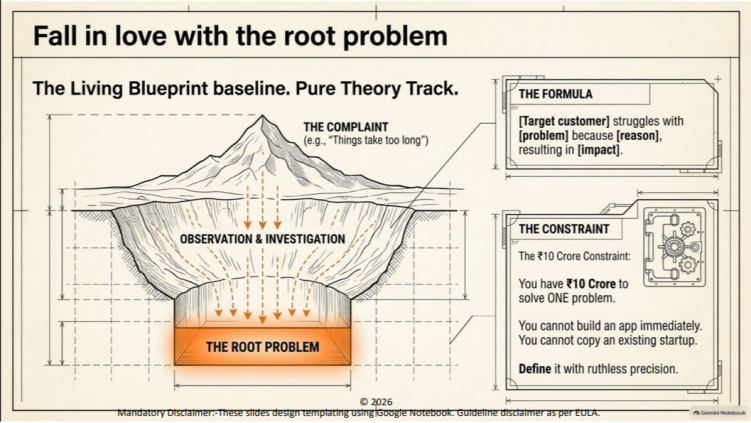
I was speaking at the Amity School Of Economics recently, doing a guest lecture for the students about the unglamorous realities of startups. You know the narrative that gets sold: infinite TAM, overnight hyper-growth, and algorithmic alchemy. Everyone wants to talk about scaling before they have even validated whether their core thesis has any bearing on reality.
In early-stage venture building and enterprise innovation alike, testing the unprecedented is rarely a software engineering problem. It is a psychological and economic discipline.
When founders and corporate innovation teams attempt to validate an unproven model, they almost always make one of two catastrophic mistakes. Either they spend eighteen months and millions in seed capital building a gold-plated, microservice-backed cathedral that nobody wants, or they release a broken, uncalibrated prototype that alienates early adopters before the feedback loop can even close.
Validation is the art of extracting high-fidelity behavioral truth with the absolute minimum deployment of capital and code.
During my lecture with the economics students at Amity, I asked a simple question: What is the cheapest experiment that can conclusively disprove your foundational assumption? If you cannot answer that within sixty seconds, you are not validating—you are gambling with other people's capital.
To test the unprecedented without incinerating runway:
1. Decouple Market Demand from Software Maturity: Test willingness to transact before engineering the automated fulfillment pipeline. If human operators cannot deliver the value proposition manually for ten customers, a Kubernetes cluster will only automate confusion.
2. Establish Pre-Mortem Invalidation Covenants: Define the exact quantitative metric that forces you to kill a feature or pivot a vertical before emotional attachment clouds executive judgment.
3. Optimize for Mean Time to Behavioral Signal: Synthetic surveys lie; customer credit card authorizations and calendar commitments do not.
When you build a disciplined architecture of validation, uncertainty ceases to be an existential threat and becomes your primary competitive advantage.
Monk, Author, TEDx Speaker, and Solution Assembler. For 23 years quietly stabilizing platforms, eliminating operational drag, and making broken systems predictable.